
Scribbling in the margins
What marginalia reveals about our inner lives and private histories
This is a repost of a piece which I first published here in September 2024, not long after I started the Broken Compass. It is an extended version of something I wrote for the ‘Bookends’ column in Literary Review the previous year. It was commissioned by David Gelber, then assistant editor at the magazine, who died of a heart attack in December 2025 aged just forty-four. It seems superfluous to append the word ‘tragic’ to that fact; I’m sure David would have struck it out. But the loss, the shock of it, his youth, still feels in need of an intensifier of some kind to articulate its impact.
David had commissioned work from me regularly over the preceding six or seven years, and I always found him to be warm, generous and witty – sometimes mischievously so – as well as perceptive, clear and firm in both his literary judgements and his wider principles. We never met, but we emailed increasingly often, particularly in what turned out to be his last months, and had planned to meet in the new year. Writing is a lonely business and connections are rare. I miss him.
This piece wouldn’t exist without David, but it seems doubly appropriate to remember him here beside a piece about fleeting human contact – how it can outlive us in the written word and briefly fool the heart into believing the impossible, that we can leap, now forward and now back, through time.
I didn’t recognise the book on my shelf. I barely noticed it, in fact, scanning the titles quickly for a different one I had mislaid. But somehow the thin tattered spine of its dusty, crumbling dust jacket caught my eye as it rested in the shadowed end of the book case.
It was one of my Dad’s from his radical student days. I had kept a few of them when we had cleared my parents’ house. Mum and Dad met in the Young Communist League a couple of years after the war. Their revolutionary ardour had faded in the 1950s, but I had always felt a fondness for those young firebrands I never knew.
I didn’t remember keeping this one, though: Musical Uproar in Moscow, by Alexander Werth, published by the Turnstile Press in 1949. Dad bought it the same year, on 7th June, a few days after his 23rd birthday; he habitually wrote the date on the endpapers. The book is about Stalin’s ideological assault on contemporary Russian composers, Shostakovich and Prokofiev among them. But what made my heart skip, flicking through its pages, wasn’t Werth’s prose or the thoughts of Soviet apparatchiks like Andrei Zhdanov. It was my Dad’s small, precise handwriting in the margins.
It was a shock. My parents taught us to treat book with respect. Writing in them was frowned upon. And yet here was my father, the same age as my son is now, arguing out loud with the author, with groupthink, with himself. So, for instance, when Zhdanov says “in modern western music there is really nothing whatsoever worth imitating”, Dad explodes in the margins: Sibelius – Strauss – Walton – Williams – Ravel!!? Nothing worth imitating from any of them!!?
We all feel that jolt of surprise and recognition when our attention snags on such stray moments on a page – brief intense expressions of a human need and compulsion to mark, to record, and remember. But it was lovely to read those words and to hear that voice again, aghast, dumbfounded, appalled – alive.
If these notes show my Dad thinking his way out of ideology’s grasp, it’s because margins often catch our unconsidered, private selves. They are where we are most revealed, most human. Earlier in the summer, I bought a copy of The King’s Arcadia: Inigo Jones and the Stuart Court by John Harris, Stephen Orgel and Roy Strong. It came , I quickly discovered, with annotations from a previous owner, inserted carefully between the pages on long strips of paper.
One such annotation runs: Inigo, a mass of misinformation, eg re copulation & breaking wind. It’s a reference to Jones’s 1601 edition of Palladio’s Architettura, on the terminal leaves of which Jones, reflecting on what age does to the body, had noted: Copulation must be utterly escheued for that thereby the best blud of a man is wasted. And: Item to break wind uppward when you cast in the mornings doth lossen mellencholy. “More than any other book,” John Harris writes, “Jones seems to have jotted comments into it throughout his life.” What I have then on these paper strips are a set of annotations regarding Jones’s own annotations in Palladio: we are suddenly in the room together, each peering over our predecessor’s shoulder, hearing the scratch of the pen, watching thought – life – happen.
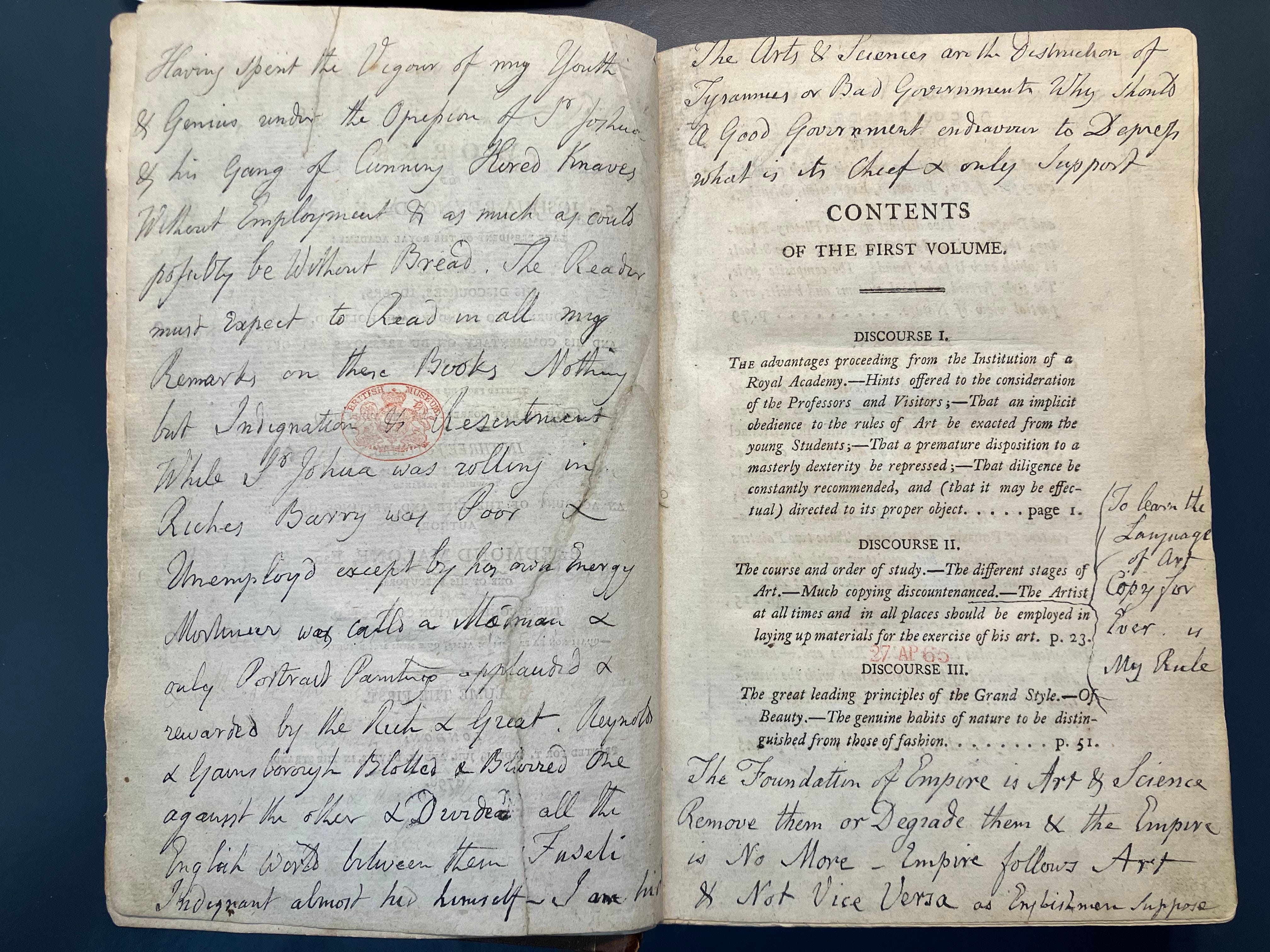
Consider too what the American poet Billy Collins has called William Blake’s “furious scribbling” in the margin of Joshua Reynolds’ Discourses, a collection of lectures on the history and practice of art, which I called up once at the British Library. (See image above.) In places, Blake’s commentary is extended enough to entirely engulf the printed text. Elsewhere his thoughts reflect the ready contempt we all feel for uncongenial writing, even if we perhaps express it with less exuberance and zeal. Villainy. A Mock. What folly. Here is nonsense! How ignorant! Never! Never! And so on. Only rarely does any of this sound notably Blakean: the visionary declaration Execution is the Chariot of Genius, for example.
But Blake doesn’t seem to be writing only for himself. The Reader must expect to Read in all my Remarks on these Books Nothing but Indignation and Resentment, he writes opposite the contents page for the first volume. In some places he has carefully overwritten his penciled comments in ink, preserving them for as-yet unborn readers in some time and at some place hence.
Medieval scriptoria, meanwhile, assumed a wide and prolonged, perhaps eternal, readership for their work. A recent exhibition of art inspired by St Francis of Assisi included some marginal art drawn by the Benedictine monk Matthew Paris in the mid 13th-century, some 20 years after the death of the saint. It shows St Francis leaning on a stick and preaching to the birds. The birds that Paris chose are a heron, a crane, a hawk, and two unidentified songsters. In reality, however, Francis actually preached to doves, crows, and a bird variously identified as a jackdaw or magpie. The drawing then lets us take a tantalising step into a medieval mind: it gives us a moment of deliberation, of art, in which Paris dresses the story in the birds that best expressed the idea of birds to him, choosing those species nesting in the valleys and rivers of his own interior life.
Prayer books and bibles were the natural and principal vehicles for transporting such human traces across long stretches of time. The impulse to record family information – births, deaths, marriages, news – in them spanned both the Reformation and the confessional divide.
My parents, neither of them religious, kept with them a bible they had found left behind in their first flat, which they moved into after they married in 1954. A small, soft-cover pocket edition from The Scottish Bible Society, it came with an inscription, To Betty & Laurie Murray on the occasion of their marriage 9th August 1952 from their minister. He added a reference: 1 Corinthians, 16, 23. The grace of our Lord Jesus Christ be with you.
Had the Murray’s marriage faltered, or did the discarded bible merely mark a hasty departure in the hurly-burly of young married life? We never knew. But a gift intended as a bible for one family became one for another. I have it still. There is more than one kind of grace, and these fleetingly human moments – the mark of new lives starting out, the gift of things that live with and outlive us, words waiting for us to alight on in the margins, or in the blank spaces that bookend every binding – are surely as keen and profound as any.
Thanks for sharing this. I love your last sentence and the unexpected fortuitous grace of discovering comments in the margins, especially when from someone one has known such as a parent at an earlier stage in their life. You get a glimpse in to their private thoughts and that moment of reading that sentence or paragraph for them. I must say I don't always recognise my own marginalia when I revisit it!
The detail that does it for me is Matthew Paris swapping in his own birds for Francis's actual audience. He wasn't recording the scene, he was unconsciously painting his own valley into it. That's what marginalia does to the annotator too, you go in to argue with the author and come out having accidentally left a self-portrait.