
Inside the Burton Mausoleum
The legendary explorer's last resting place, shut for seventy years, opens to the public
Who would turn down the opportunity to enter a late-Victorian mausoleum – never mind one that holds the remains of such a storied man as the writer and explorer Sir Richard Burton? Some people perhaps, but not us. We visited on a gorgeous spring weekend a couple of weeks ago.
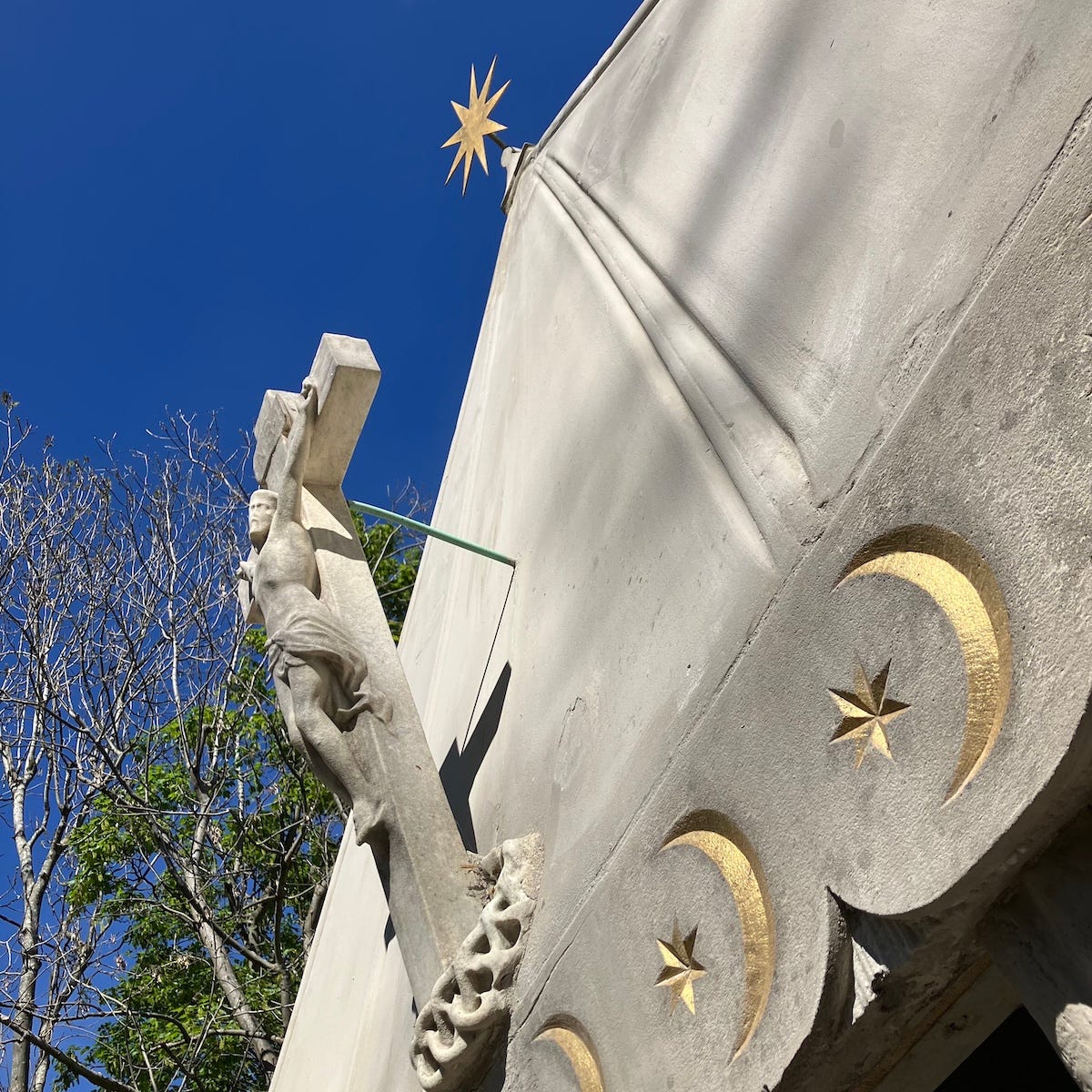
The mausoleum is in the cemetery of the Catholic church of St Mary Magdalene in Mortlake, south-west London, between the Waterloo-Richmond rail line and the Thames. What’s striking about it, of course, is that it’s shaped like an Arabian tent, despite being carved from sandstone and Carrara marble. It was designed by his widow, Lady Isabel, to meet his somewhat impractical wish that their remains should rest in a tent such as they used in their travels together in Syria – and to meet her own wish, as a devout Catholic, that they should both ultimately lie together on consecrated ground. That tension – or is it a contradiction – runs through everything you see.
Burton, who was born in 1821, was a legendary figure during his lifetime: he had “a wider soul than the world was wide”, Swinburne would write in his elegy. He cemented his fame in 1853 by undertaking the hajj, the annual Islamic pilrimage to Mecca, disguised as Sheikh Abdullah, a wandering Sufi dervish and practitioner of medicine. Whatever one thinks of the ethics of such journeys, that he did so successfully is testament to both his extraordinary facility for languages – the precise number seems to vary but the DNB has him fluent in forty different tongues – and deep immersion in local manners and mores. A similar journey the following year to Harar in Somalia disguised as a Turkish merchant was less successful, however. It seems likely that Burton had to kill a man to escape exposure; he was fond in later life of boasting that he had broken all ten of the commandments. Offending propriety amused him.
His search for the source of the Nile in the late 1850s, accompanied by his friend John Speke, resulted in one of the great controversies of the age. Together they discovered Lake Tanganyika; Speke alone discovered Lake Victoria. Each believed a different lake to be the source: Burton the former, Speke the latter. (It later transpired that Speke was right, but he had no proof of his claim.) Speke returned to London a few weeks ahead of Burton in early 1859 and proceeded to take the lion’s share of the credit for their work.
The very public acrimony that ensued did not abate until Speke’s accidental death in September 1864 from a gunshot wound. He had been shooting partridge in Wiltshire; the following day he and Burton were due to debate their explorations. Burton was happy to suggest that Speke had killed himself to avoid public exposure, although given that the entry wound was under Speke’s armpit that seems unlikely. Nevertheless, the rupture between the men is evidence of Burton’s talent for falling out with those around him, not least his superiors: “he had an iron will and an over-weening self-confidence, which doubtless saw him through many dangers,” the Times wrote after his death, “But he was a man who would have his way, and he could make things remarkably unpleasant for those who crossed him.”


Burton’s reputation today probably rests on his translation of The Thousand and One Nights, the famous collection of Middle Eastern and other folktales. Burton’s translation is called The Book of the Thousand Nights and a Night, and it was distinctive for retaining the sexual content of the originals, which, together with Burton’s detailed annotations, resulted in it being printed privately to evade nineteenth-century obscenity laws. Despite that – or perhaps because of it – the translation was an enormous success.
Burton was a prolific writer, publishing over forty books, many of them narratives of his travels, primarily around Africa, the Middle East and India. In later life and in failing health, his work tended towards translation - The Luciads of Camões, for example – which often encompassed his life-long passion for ethnography. He was particulary interested in human sexuality – I suppose now he might be called a sexologist – and in 1882 founded the Kama Shastra Society, under whose auspices he privately published translations of the Kama Sutra and The Perfumed Garden of the Cheikh Nefzaoui: A Manual of Arabian Erotology. (He also translated classical erotica in the form of the Priapeia and the works of Catullus.)
Burton might be interred in a Catholic cemetery, but his faith is unknowable. He was certainly deeply attracted to Sufism. His widow, Lady Isabel, described him as “half Sufi, half Catholic” – or, more truthfully, she said, “alternately Sufi and Catholic”. Many - friends and foes alike - thought him a freethinking agnostic. So there is a little bleak comedy, for those who like such things, in the scene around Burton’s death bed in Trieste, where Lady Isabel wrestled reality for his soul. Burton was sixty-nine and they had been living in the city, then part of the Austro-Hungarian empire, on and off since 1872. He woke at four in the morning on 20 October 1890 complaining of great pain. A doctor was summoned. Within half an hour Burton was gasping for breath. He died around five a.m.


But for the next two hours Lady Isabel begged the doctor to keep attempting to restart Burton’s heart with shocks from a battery – one electrode on the heart, the other on the shoulder bone. When the priest arrived at seven a.m. he concluded, not wrongly, that Burton was already dead and therefore beyond the help of last rites, which can only be administered to the living. Intent on saving his mortal soul, Isabel insisted that he was indeed still alive. She also insisted that he had undergone a secret conversion to Catholicism, which was news to the priest. In the end he relented and said his prayers; the doctor could finally give up on the charade of resuscitation and declare Burton dead. Isabel, however, spent the next forty-eight hours hoping – and no doubt believing – that he was simply in a coma. Perhaps relatedly, she was herself terrified of being buried alive: her own last will and testament required that her heart be pierced with a needle to prove death beyond doubt. Perhaps it was simply the first paroxysms of grief. She later wrote to a friend: “He was dead before extreme unction was administered; and my sole idea was to satisfy myself that he and I would be buried according to the Catholic rites and lie together above ground in the Catholic cemetery.”
Some 100,000 people attended Burton’s funeral in Trieste, which was accompanied by three church services and, Lady Isabel reported, 1,100 masses “for the repose of his soul”. Would that have been enough, people wondered, contemplating her husband’s reputation. His embalmed body rested on a catafalque in the Catholic cemetery before starting on its journey back to Britain. Rumours circulated that he was brought back in a piano case, but his corpse lay inside a lead coffin with a window over his face, itself inside a second coffin of gilded steel, which is the one you can see in the mausoleum today. The coffin arrived on the SS Palmyra, which docked in Liverpool in early February the following year. On 7 February it was brought to Mortlake and St Mary Magdalene where it was placed in the crypt beneath the altar while the mausoleum was built. (Westminster Abbey had been sounded out as a possible resting place, but the dean refused, claiming – not entirely honestly – that the abbey was full.)
Building the mausoleum was slow. Lady Burton had launched an appeal to pay for it as a mark of the nation’s gratitude towards her husband a few weeks after his death. She had hoped for £950. By the end of February, she had received just under £140, all of it donated by friends – just twenty-four of them. She was compelled to write to the Times – one biographer describes it as a begging letter – in the hope of raising the rest.
The free-thinking element of Burton’s psychology seems both hard to deny and difficult to reconcile with the Catholicism by which he was annexed after death. But it is impossible to know the extent to which what happened accorded with his wishes. Lady Isabel claimed, not unreasonably, that they had been married for nearly thirty years and she knew his mind better than anyone. He, surely, also knew hers and her likely choices. They had, after all, purchased the plot in Mortlake together two decades earlier. Many of her relatives were buried there already; Burton called it their “nice little family hotel”.
But most of his friends and family were horrified. “Rome took possession of Richard Burton’s corpse, and pretended, moreover, with insufferable insolence, to take under her protection his soul,” Burton’s niece Georgiana Stisted wrote bitterly. It was the “ecclesiastical triumph of a faith he had always loathed”. Some eight hundred invitations went out for the funeral ceremony in London, which was held on 15 June 1891, but over four hundred declined. Lady Isabel put this down to an outbreak of flu; an allergy to Catholicism surely accounted for many of them. Burton’s friend Sir Francis Galton, who did attend, described the funeral as “a ceremony quite alien to anything I could conceive him to care for”. Lady Isabel, at least, cared for it very much. Her grief was tempestuous, it was said; she seemed “one of the Eumenides”.


If the religious flavour of Burton’s funerary rites alienated his widow from many of his friends, it was just a hint of the fury that would erupt when she revealed the fate of his papers. After his death she had locked herself away for sixteen days in Trieste and burned most of them. She gave various and contradictory accounts of her motives for this – one of them, unwisely publicising the occurence, in a letter to the Morning Post. Not to be ruled out, I think, is overwhelming grief and the difficulty of thinking clearly so soon after so great a loss, although that is not one of the explanations she gave. Most Burton biographers seem to share the contemporary view that her actions revealed her to be an “illiterate woman with the bigotry of a Torquemada and the vandalism of a John Knox”. Mary S. Lovell’s Rage to Live, a joint biography of the couple, is notably more sympathetic, arguing that the bulk of the destruction came later after Lady Isabel’s own death in 1896.
Precisely what she burned – and its value – is, I think, open to question. Given the extent of Burton’s travels, his unique linguistic skills, and his unusually wide range of ethnographic interests, his journals and notebooks certainly seem a loss both to scholarship and posterity. At the time, attention focused particularly on a new version of The Perfumed Garden - now titled The Scented Garden – which Burton had translated directly from the Arabic himself. (The earlier edition was based on a French translation.) This reportedly contained 882 pages of texts and footnotes, 150 pages of prefatory and other additional matter, and a 200-page treatise on what Lady Isabel delicately referred to “a certain passion”, by which she meant homosexuality, the hint of which had tainted Burton’s career since he had been tasked with investigating male brothels – in disguise, naturally – while serving in the British army in India in the 1840s.
Lady Isabel herself said that Burton regarded The Scented Garden as his magnum opus, and that he was due to finish it on the day of his death. “I have put my whole life and all my life blood into that Scented Garden,” Burton had said, “and it is my great hope that I shall live by it. It is the crown of my life.” Even so, it is hard to over-state the abuse that Lady Isabel received as a result of her decision – bearing in mind that the book would have had limited circulation, being printed privately on account of its scandalous contents. “It is not my part to strip and whip the popish mendacities of that poor liar Lady Burton,” wrote Swinburne, who had hitherto held her in high regard. “Of course she has befouled Richard Burton’s memory like a harpy.”
Lady Burton’s initial explanation to the Morning Post made it clear that it was the book’s treatment of homosexuality that alarmed her. “My husband had been collecting for fourteen years information and materials on a certain subject,” she wrote. And while, had he lived, he would have been able to defend his reputation, it was a different matter now that he was dead. Moreover, she explained, it was more than his reputation that worried her.
I remained for three days in a state of perfect torture as to what I ought to do about it… I can take in the world, but I cannot deceive God Almighty, who holds my husband’s soul in His hands... I said to myself, ‘out of fifteen hundred men, fifteen will probably read it in the spirit of science in which it was written; the other fourteen hundred and eighty-five will read it for filth’s sake, and pass it to their friends, and the harm done may be incalculable’...
What a gentleman, a scholar, a man of the world may write when living, he would see very differently to what the poor soul would see standing naked before its God, with its good or evil deeds alone to answer for.
But to a friend she wrote that Burton’s spirit had appeared before her on three separate occasions and commanded her to burn the manuscript. Lady Isabel, her spiritualism not much less ardent than her Catholicism, felt compelled to acquiesce. “Shall I let his soul be left out in cold and darkness till the end of time,” she remembered asking herself, “till all the sins which may be committed on reading those writings have been expiated, or passed away, perhaps, for ever?”


All of which is to say that the mausoleum in Mortlake reflects a particular vision of the couple’s lives and embodies something of the contest over his memory. I think you have to decide for yourself whether both the Sufi and the Catholic aspects of Burton are equally represented; the freethinker is not. The outside of the it carries very clear Christian and Islamic symbolism in the shape of the cross and the crescents and stars. Inside the story is more complex.
The two coffins lie on either side. (Lady Isabel’s sister is buried in the floor, which struck me as odd for a funerary structure so determined to make a statement about the Burtons’ uniqueness.) But what you see first is the small altar opposite the door, with its statue of the Virgin Mary – peeling paintwork making it look a little like she suffers from vitiligo – around whose neck hangs a portrait miniature of a young, uniformed Richard Burton dating to his days as an ensign in the Indian Army. I found the casual intimacy of the objects’ conjunction moving, as if the painting had only just been placed there and for a moment only; it offered a sad and thrilling sense of the force of her devotion to him, its charge still hazy in the cool dry air.
Lamps of coloured glass hang from the ceiling, and the various shelves are lined with glass flasks, incense burners and iron lamps, mostly of Arab origin, I think. (It has been speculated that one of the flasks might once have contained water from the sacred well which Burton brought back from Mecca, but I don’t know the truth of that.) There is nothing apparently precious; the effect is almost homely and certainly personal. In one corner, under glass, is a wreath from Burton’s funeral.
A line from the Gospel of St Luke runs around the walls: “Stay with us because it is towards evening and the day is far spent.” Hanging at the apex of the roof is a hand of Fatima, although what you notice most are the roundels painted on the ceiling and walls which contain cherubim. They are not the best examples of such work, in all honesty, but neither are they the originals: they were described as “beyond recognition” in 1925 when the first restoration campaign was launched; there was a second campaign in the 1970s, supported by Sir David Attenborough among others, to restore the exterior.
Also draping from the apex are lines of camel bells so that the sound of the desert might be heard through the tomb: Lady Isabel installed a battery-powered system, now long decayed, to make them chime whenever the door was open. She often came to sit here herself – she held several séances here, with what results I don’t know – and visitors were welcome. There is a clear glass window above the altar, installed as part of the 1970s restoration. It had been originally been a panel of stained glass containing Burton’s monogram – he hated to lie in darkness – but that was smashed when the mausoleum was vandalised in the 1950s. (The thieves had hoped there might be treasure inside; it is not thought anything of value was taken.) It was then that the mausoleum was bricked up, the window opening covered by a sheet of tin. It must have made a sorry sight.
The latest restoration has been undertaken by a local charity, Habitats and Heritage, which has done a wonderful job in making the mausoleum available to visitors again. Click here to read more about the project and book a visit yourself. I highly recommend it. Caitlin Jones, who has led the Habitats and Heritage project, was acting as our guide when we visited, and she did an excellent job of contextualising both the Burtons and the mausoleum itself. (Obviously, she has much more information about the various artefacts – and more besides – than I am able to offer here.)
Burton’s favourite persona, the DNB says, was that of Mirza Abdullah, half Arab and half Iranian, whose trade varied according to the perils and demands of the moment. “What scenes he saw!” Burton wrote of Mirza. “What adventures he went through! But who would believe, even if he ventured to detail them?” Burton cultivated his own myth, but it seems impossible to deny his gifts and daring, nor the terrible intensity of his self-belief. What would we think of him now, had Lady Isabel preserved his journals and daybooks? Some kind of man, perhaps; some kind of monster. If she feared the latter judgement, it’s important to note that her monsters were other than our own. The monsters of tomorrow might be different yet.
Reading about Burton over the last couple of weeks, I suspect that the mausoleum represents Lady Isabel’s romantic ideal of her husband more than the man himself. I doubt he cared much what happened to his body after death and was content that she should be at peace no matter what. But I have found myself thinking about him, alone in his coffin within a coffin with its strange interior window, with all his multiple selves. He was not fond of saying goodbye. “Au revoir,” he liked to say on parting. He might still be there now, confined to travel through some interior wilderness, brooding darkly, brilliantly, on his next disguise.
If you’ve enjoyed reading this and you’re not a paid subscriber, small donations to support my work are also very much appreciated. Just click on this link!
Mathew, thanks for this fascinating post. We went to see the mausoleum a few years ago when we were in London. It's very neat, though of course we couldn't get inside. I also appreciate your very balanced take on Burton and Lady Isabel, including her decision to destroy many of his papers. While it would obviously be interesting to see those, people sometimes talk as though humanity had a "right" to the personal papers (and secrets) of famous people, which has always seemed untenable to me.
What a fascinating post!