
The fall of the Duke of Norfolk
Come at the Queen, you best not miss…
A few weeks ago, I highlighted this 1562 portrait of Thomas Howard, the fourth Duke of Norfolk, by Hans Eworth, which was up for auction at Sotheby’s. (It sold for £3.2 million in the end, and happily was bought by the current Duke of Norfolk to hang in Arundel Castle.) As I intimated, Howard was at once a complex and a shallow man, and I thought this account of his complicity in plots against Elizabeth I, and his ultimate downfall, might be of interest.
Everything you need to know about him can be read in the wary arrogance that Eworth has captured in his eyes. To find out why, read on…
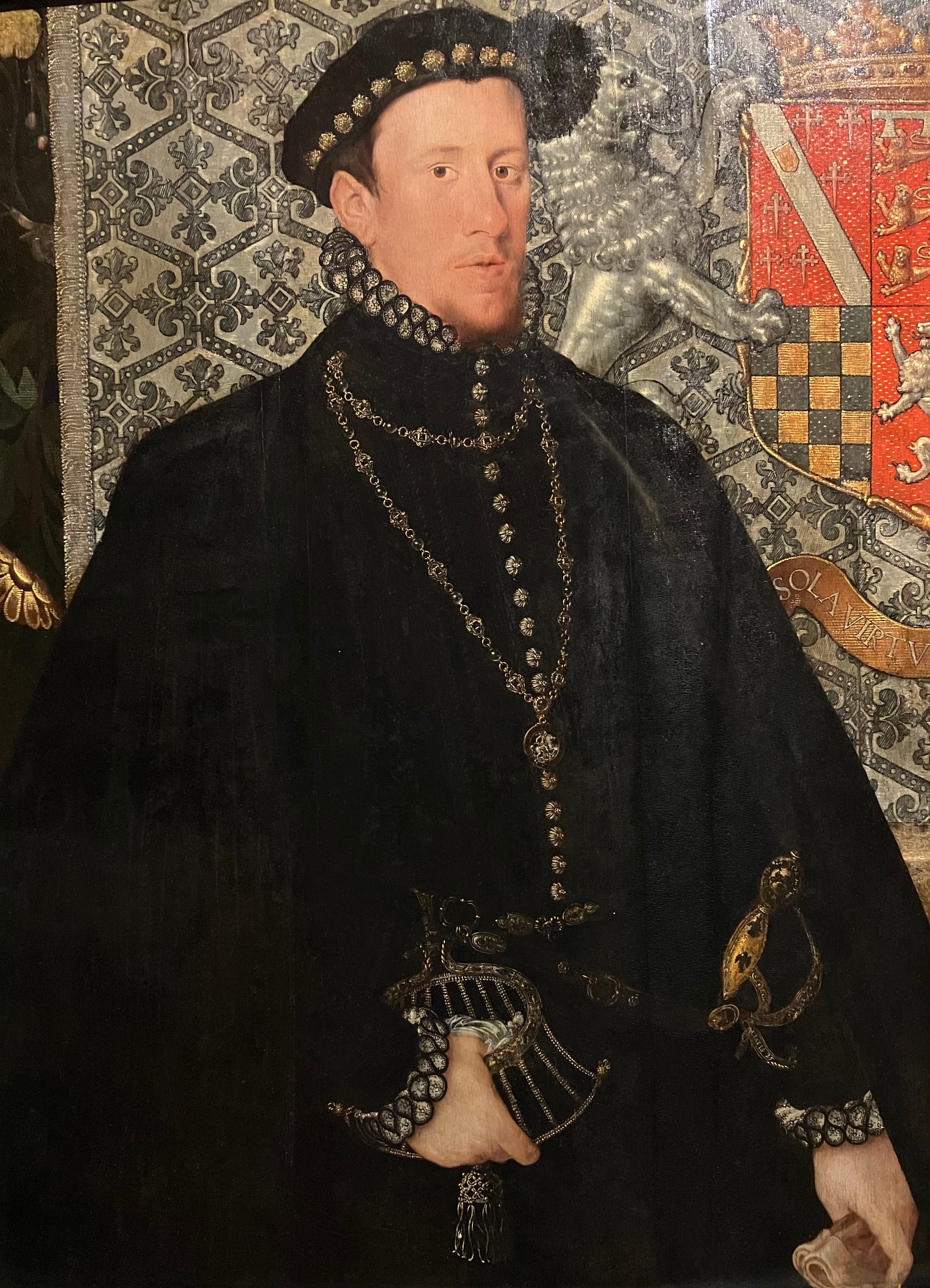
On 16 May 1568 the regnant Scottish queen Mary Stuart arrived in England. A Catholic, she had been deposed, marginalised and effectively disowned by the Protestant establishment in Scotland, where her young son James VI, aged thirteen in 1569, was now a minority king.
Mary was the granddaughter of Henry VIII’s sister Margaret, and therefore had a strong claim to the crown of England. It was the strongest claim after Elizabeth’s, some thought. But for those who regarded Elizabeth’s dubious legitimacy as the child of Anne Boleyn sufficient to bar her from the throne, Mary was the rightful queen.
Mary had made her own ambitions quite clear by proudly quartering the English coat of arms with her own when she learned of Mary Tudor’s death in 1558. A later report has her joining a group discussing a portrait of Elizabeth. Was it a good likeness of the queen of England? “Nay, it is not like her, for I am the Queen of England,” Mary replied.
Mary’s arrival in England in 1568 therefore created a problem for Elizabeth’s government. As the Spanish ambassador astutely observed the following week:
They must be somewhat embarrassed… although these people are glad enough to have her in their hands, they have many things to consider. If they keep her as if in prison, it will probably scandalise all neighbouring princes, and if she remain free and able to communicate with her friends, great suspicions will be aroused.
The English chose scandal and prison. But the government also explored ways of peacefully restoring Mary to Scotland that would also bind her politically to England.
One possible solution was for Mary to marry an English nobleman. Elizabeth, who had once been a supporter of such a strategy, now forbade it: it gave Mary too great a purchase on the English throne. Which was no doubt one of the attractions for Mary. She found the ideal candidate in the shape of Thomas Howard, fourth Duke of Norfolk.
Norfolk was the pre-eminent nobleman of the realm, England’s only duke, and immensely popular in his own fiefdom: “It is almost incredible how dearly the people loved him, and how by his natural benignity and courteous actions… he had gained the hearts of the multitude,” wrote the historian William Camden.
Perhaps unsurprisingly, the thirty-year-old Norfolk had a high regard for himself and his position in society: he once boasted to Elizabeth that his “revenues in England were not much less than those of the Kingdom of Scotland… and that when he was in his tennis court in Norwich, he thought himself in manner equal to some kings”.
In some ways that statement tells you all you need to know about Norfolk: his self-importance struggling against dilettantism, naivety, and a fundamental unseriousness of purpose. But stratospheric vanity was a familial flaw: the impossible self-worth of the Howards had led Norfolk’s father and great-grandfather to the executioner’s block under Henry VIII. His father, the Earl of Surrey, the last person to be executed for treason under Henry had quartered his arms with those of Edward the Confessor, as if in challenge to the hereditary claims of every monarch since, the Tudors included. Norfolk’s grandfather, likewise under sentence of death for treason, was only reprieved by the death of Henry himself.
It is unclear who first mooted the idea of a marriage with Mary to Howard, although his name had been floating around as a possible suitor for Mary for several years. But it was certainly being actively discussed by Howard himself by mid-October 1568. Discretion was not his strongest suit; the idea had reached the ears of the new French ambassador by the end of the month.
Elizabeth herself heard the rumours around the same time and gently confronted Howard. He replied that “no reason could move him to like of her that hath been a competitor to the crown; and if her majesty would move him thereto he will rather be committed to the Tower, for he meant never to marry such a person, where he could not be sure of his pillow”, a reference to the murder of Mary’s second husband Darnley.
It was not so much the idea of the Howard-Stuart match that concerned Elizabeth, although anything that might seem to strengthen Mary’s claim was certainly unwelcome. It was the secrecy and deceit that surrounded it. She was right to be concerned.
Mary agreed to the marriage in June 1569. Elizabeth persisted in offering Norfolk opportunities to clear the air. At the end of July, in the garden at Greenwich one morning, Elizabeth called Norfolk over and asked if he had any news for her. Norfolk said not. “No?” asked Elizabeth. “You come from London, and can tell no news of a marriage?” A lady in waiting approached with some flowers for the queen and Norwich took the opportunity to withdraw.
Two weeks later, on progress with the queen in Kent, she summoned him to dine with her. “At the end of dinner,” Norfolk later recalled, “her majesty gave me a nip, saying that she would wish me ‘to take good heed to my pillow’. I was abashed at her majesty’s speech, but I thought it not fit time nor place there to trouble her.”
There is, perhaps, a certain charm to such diffidence, but for Norfolk it would prove deadly. Elizabeth’s evident fondness for her “right trusty and right entirely beloved cousin” wasn’t limitless.
By the time they reached the Earl of Southampton’s mansion at Titchfield, overlooking the Solent, on 6 September that year, Norfolk’s time was running out. “At that house, in the gallery,” Norfolk remembered, “it pleased her majesty to call me, and there used such speech, or to that effect, as I remember I have confessed in my examinations, and upon calling myself to memory, I think her highness charged me with my allegiance to deal no further with the Scottish cause.” The shifting, squirming syntax betrays Norfolk’s moral discomfort, his emotional disquiet.
From being the most powerful nobleman in England, Norfolk overnight became damaged goods. “Everybody began to be afraid to keep me company,” he reflected ruefully. “Where before [my table] was ever replenished as full of gentlemen as could sit at it, now if I could get three or four to dine with me, it was all.”
Norfolk left court for London on 15 September without seeking permission, evidently hurt, uncomprehending of the dissonance between his self-image and the persona he in fact projected. “I am right sorry that no man can keep me company without offence,” he wrote to Cecil that day. “ I never deserved to be so ill thought of.”
Elizabeth ordered him to return to court. On 22 September, a week later, Norfolk removed further—to his great palace at Kenninghall, outside Norwich, claiming illness. His distress seems honest enough, caught between the public shame of becoming “a suspected person” and the private horror of imprisonment in the Tower, “which is so great a terror for a true man”. It seems not to have occurred to him that retreating further within his eastern kingdom was the path of least safety.
Orders went out to place Mary Stuart under greater security, to restrict her household and to ensure that all her correspondence passed through English hands first: “for a season she shall neither send nor receive any message or letters without our knowledge,” Elizabeth wrote. The growing belief at court was that Norfolk had fled to lead a rebellion.
Three days later, Elizabeth wrote again to him demanding he report to court immediately, “without any delay upon the sight of these letters, and without any manner of excuse to come forthwith”. By 28 September all semblence of patience was gone: Lord Wentworth was sent to bring Norfolk in no matter what.
Norfolk was under house arrest by 3 October, and in the Tower a week later. It was here, to add to his troubles, that he met the well-connected, but dangerous and untrustworthy Thomas Cobham.
