
History in plain sight: St Michael and All Angels at Copford, Essex
A pilgrimage and a revelation
I had always rather assumed that disdain for the county of Essex was a modern, if not a contemporary phenomenon; perhaps that’s just because I think of ‘Essex man’ and ‘Essex girl’ as Thatcher-era terms of bourgeois revulsion. But contempt for the area seems to stretch back some time. “Essex,” Herbert Tomkins wrote in his 1938 companion to the county, “for many years, was even as a Cinderella in the eyes of the tourists.” He goes on to recall people speaking disparagingly of it in Queen Victoria’s day.
For my part, it’s a county I never get tired of exploring. I wrote about two of its churches in another post last year, and we visited a few more this last weekend. I’m only going to write about one of them now though, simply because it is so remarkable.
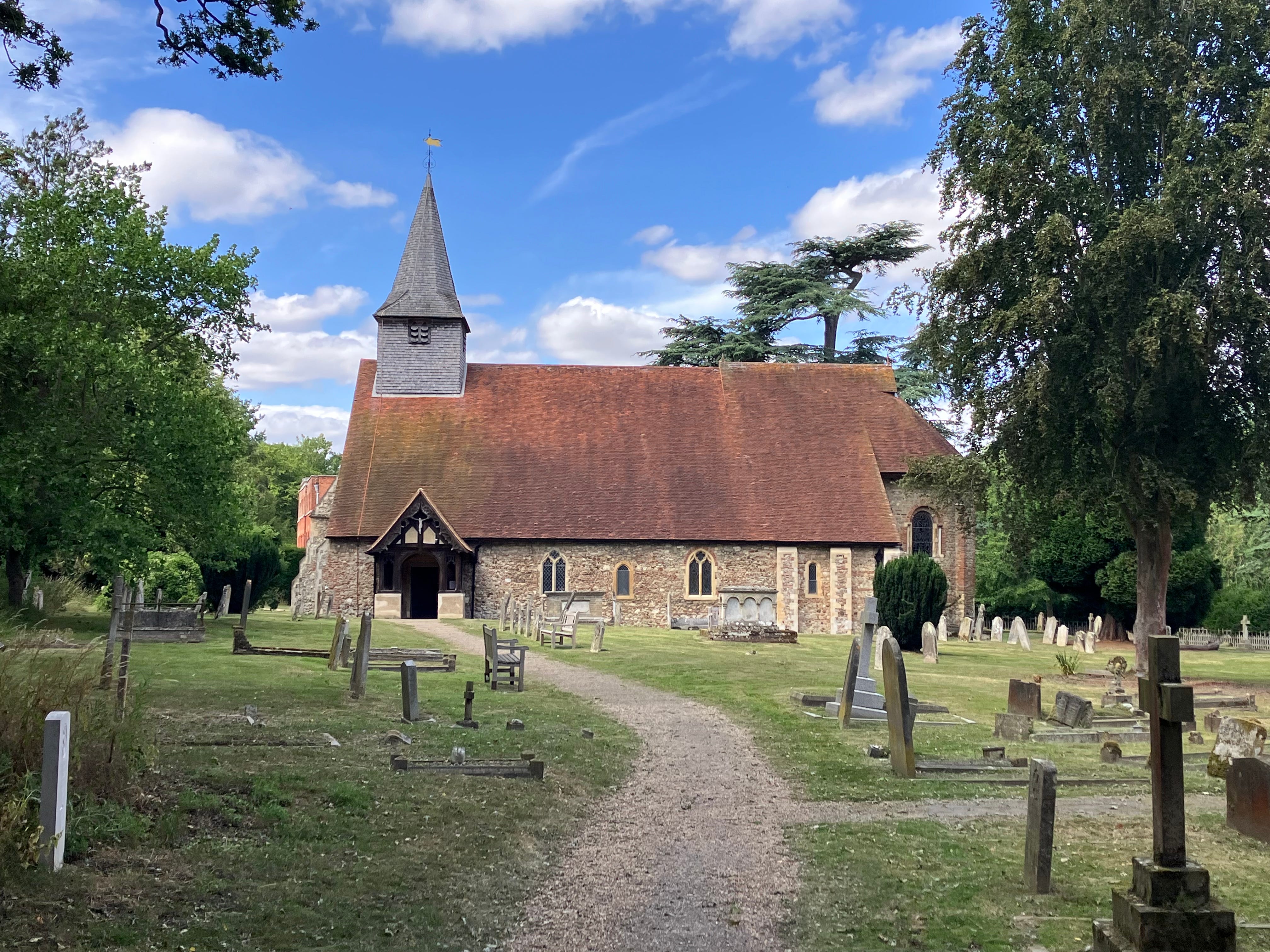
The church in question is St Michael and All Angels in Copford, a little to the west of Colchester. It’s some way outside the village, located in a clearing amongst the trees between a cricket ground and the Georgian-era Copford Hall. “It is almost the beau ideal of what to the foreigner is an English landscape scene,” Pevsner writes in his guide. However awkward the syntax, the sentiment is true enough. The setting is so English it hurts.
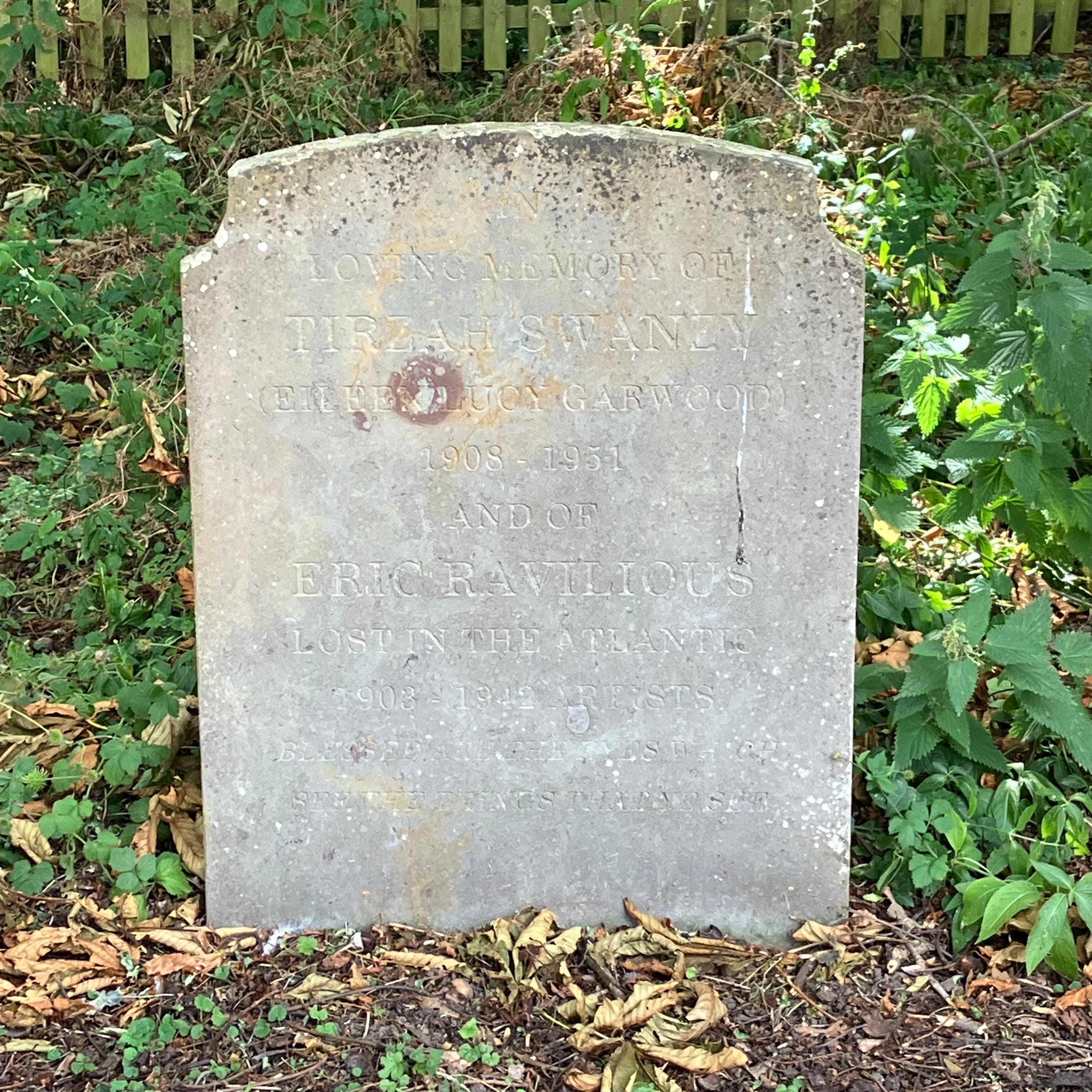
We were there on a sort of pilgrimage to look for the grave of the artist Tirzah Garwood, whose work is in the process of being rediscovered after decades of neglect following her death in 1951 aged forty-two. I had the great privilege of reviewing the first major retrospective of her work, which was put on by the Dulwich Picture Gallery in 2024. Her grave lies under some trees close to the cricket ground; the sound of a game, its rhythms – leather on willow, shouts and cries, silences – hung in the hot summer air.
I hadn’t realised, but Garwood’s gravestone also commemorates her first husband and fellow artist Eric Ravilious, who was lost at sea in 1942. “Blessed are the eyes that see the things that ye see,” is the inscription from Luke’s Gospel. Both were part of the group at nearby Great Bardfield in the 1930s alongside Edward Bawden and others, producing figurative work that pulses in different ways with an intense kind of Englishness, luminous and playful, its visionary ecstasies in exquisite tension with its precision and restraint.
Garwood’s work in particular has a powerful, dreamlike interiority. I don’t know why St Michael and All Angels was chosen for her burial. Perhaps it was her wish. Perhaps it was simply because she died at a nursing home in Colchester. But it makes sense, because entering the church transports you to another England entirely.
From the outside, as you approach it from the gate, it doesn’t immediately strike you as a distinctive and unusual building. True, there is that large expanse of unbroken roof. And yes, there is the wooden bell tower – something that, rightly or wrongly, I think of as characteristic of a certain kind of Essex church. This one was added in the late fourteenth or early fifteenth century, the Victoria County History says.
I’m secretly rather fascinated by the world of campanology, so I was pleased to learn that the wooden belfry has three bells, dating to around 1420, 1440 and 1574. (I’ve written more on bells and bell-ringing here.) The earliest has the inscription Sum rosa pulsata mundi Katerina vocata, ‘When struck, I am called Catherine, the rose of the world’. An altar to St Catherine was recorded at Copford in 1526; it was presumably destroyed at the Reformation. Bells at Little Bardfield, Great Braxted and Laindon Clays share, or shared, the same inscription. The 1574 bell has the somewhat more elliptical Dog feare, which AJ Wright, in his informative guide to the church, suggests might be a possible transposition of ‘Feare God’: the initials of the bell’s founders are reversed in the inscription and at least part of the date inverted. I have no idea what the intention was, but it’s pleasingly strange nonetheless.
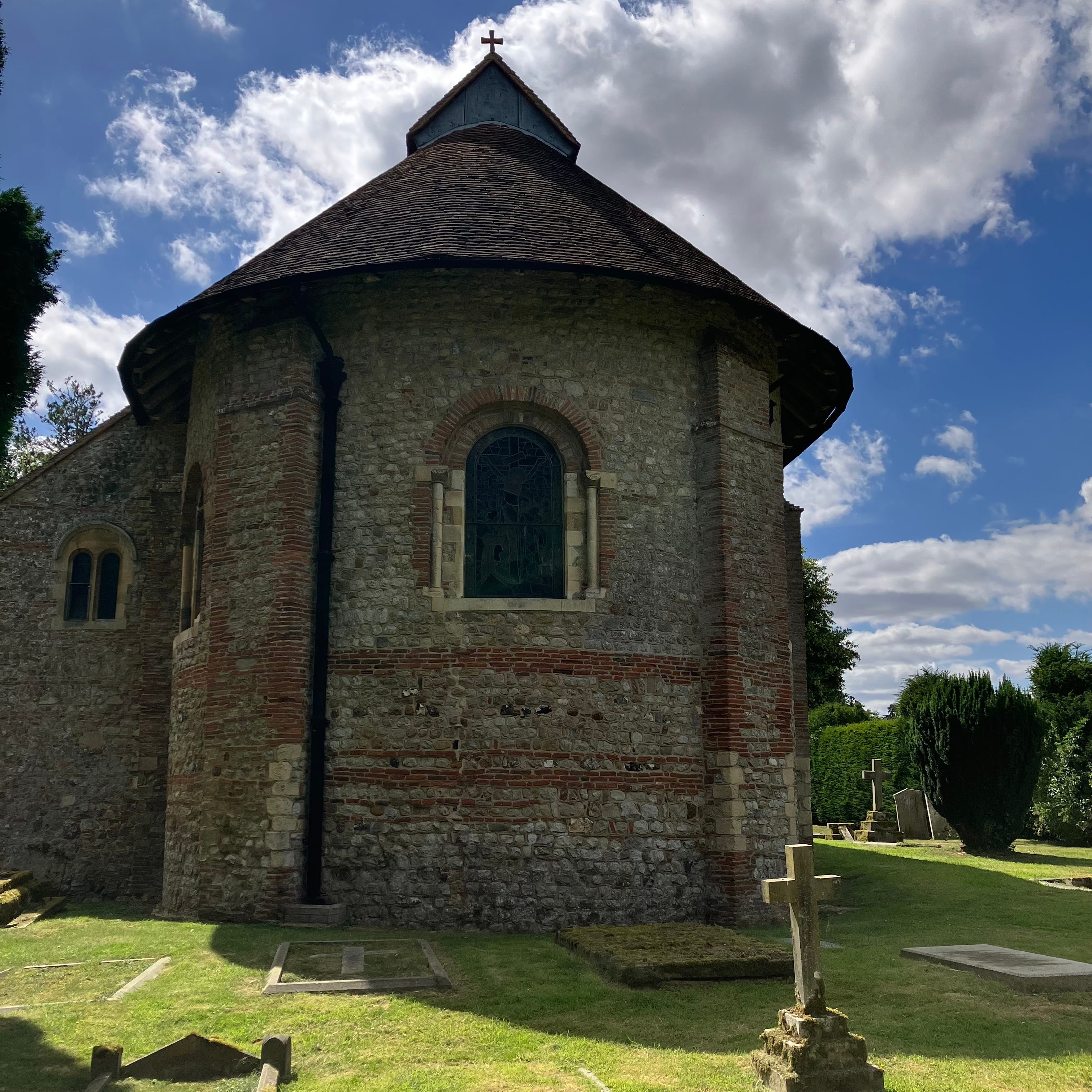
At first sight you would probably think the whole building fourteenth or fifteenth century. Then you walk around to the east and see the exterior of the apse: suddenly you are two or three centuries earlier and anywhere in Europe under the influence of Byzantine or Romanesque design. There are whole courses comprised entirely of Roman brick, which is also used extensively in the buttresses. What was quintessentially English has melted away into something that speaks to another England, a not-yet England, precarious and ill-defined.
In fact, the manor of Copford belonged to the Bishops of London long before the Norman Conquest – at least as early as the tenth century – and there is evidence of an Anglo-Saxon structure to the south east of the current church. It remained in episcopal ownership until 1559 when the then Bishop, Edmund Bonner – of whom more later – was dispossessed by the newly crowned Elizabeth I. History is tightly woven here.
The church, originally dedicated to St Mary the Virgin, was built c1125–30 and likely functioned as a chapel for the bishops. (The current dedication dates from 1880.) That certainly goes a little way in explaining what you see when you get inside. It is, as Pevnser notes, with characteristic understatement, “the most remarkable Norman parish church in Essex”. I mean, look at the interior of the apse.
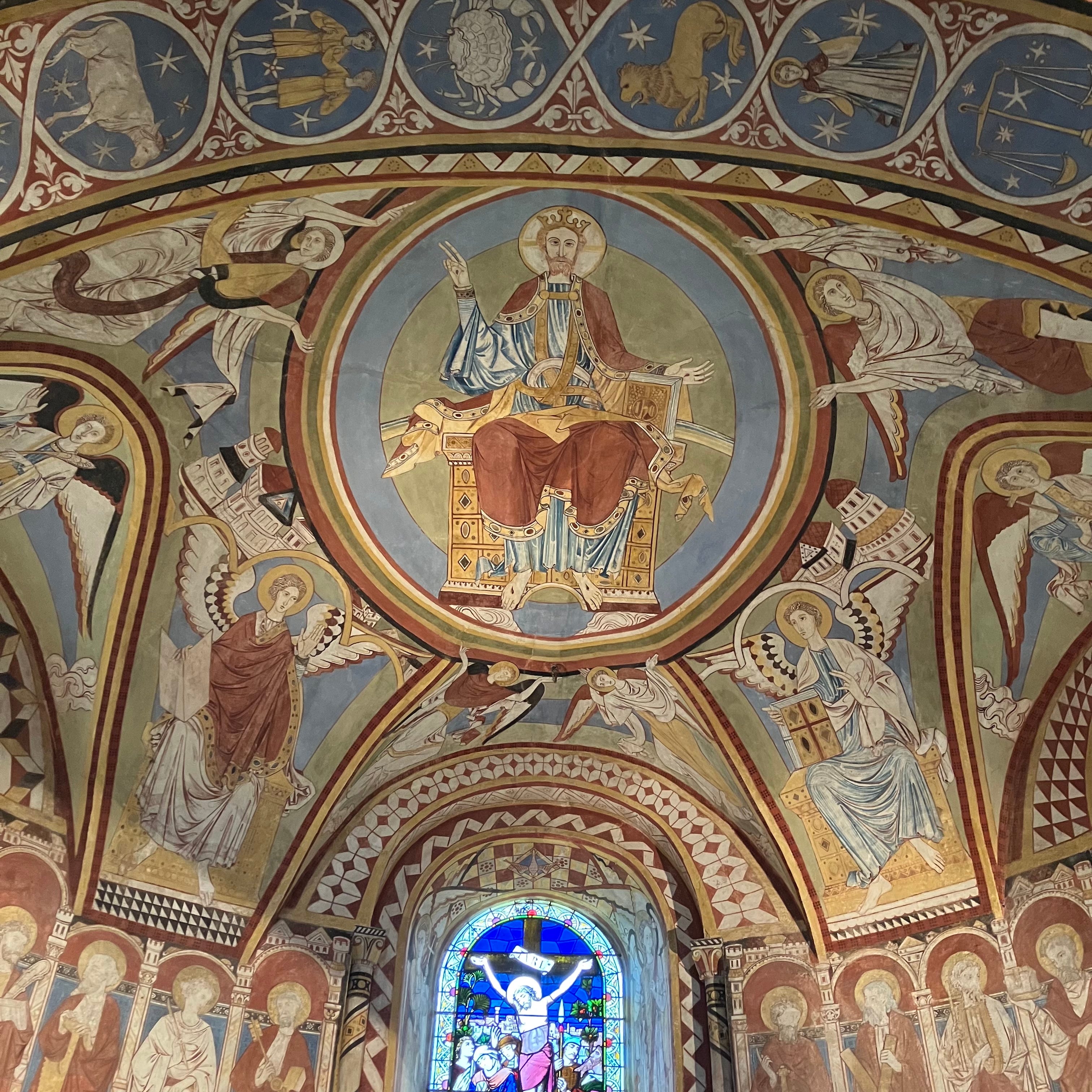
No, we weren’t expecting that either. We might be almost anywhere around the Mediterranean or the Adriatic. But we are still in deepest Essex. The murals are contemporaneous with the building: they are true frescoes, painted into wet plaster. To imagine what it looked like – well, we can’t do that, in all honesty – but to get a sense of it in its pristine state, we need to dig a little into the architectural history of the church. Go back to the exterior photo of the apse. Imagine it without the additional building to the left – which someone, I can’t find the reference now, has unkindly referred to as a medieval lean-to – and you have the church of 1130, tidily shaped liked a round-nosed bullet.
When it was first built, the ceiling of the nave was vaulted. There doesn’t seem to be a consensus about the nature of the vaulting – it was most likely a groin vault – but what is certain is that murals like those in the apse would have originally covered all the wall surfaces, as well as the ceiling. Wright estimates that there would have been around thirty-four individual images or subjects portrayed. Imagine that. I’m thinking of a more modestly Romanesque Scrovegni Chapel.
It’s easy to lament the losses from our contemporary vantage point, of course, when such things have become vanishingly rare and our urge is towards preserving all things at almost any cost. But we are an outlier: our ancestors were less sentimental. The first tract of mural had already been destroyed by the end of the twelfth century when a bay was created in the south wall of the nave, and the creation of the south aisle over the next couple of centuries – that late-medieval lean-to – impelled the destruction of two more. The vaulting over the nave – again, yes, all of it covered in mural – came down around 1400. Wright’s theory is that successive medieval builders chanced their arm punching bays into the nave’s south wall and hoping that what remained was strong enough to support the ceiling. But eventually their luck ran out and the vaulting cracked.


Who knows what might have happened here had the Reformation not intervened. The reality is, however, that the murals were all white washed in 1547 or so during the reign of Edward VI. It happened everywhere across England; I sometimes wonder what that moment must have been like, all these familiar images, the everyday sensual and memorial impress of them, drowned in blankness, a visual language dumbed and silenced, a universe of meaning extinguished, execrated and denied. Shakespeare’s father oversaw a similar process at the Guild Chapel in Stratford, although it’s perhaps instructive to compare the vastly different style of wall paintings there to get a sense of how rare, how much older, those at Copford really are.
But as with Nottingham alabaster, these things have a way of resurfacing, of making themselves remembered. Writing around 1700, Richard Newcourt noted in his parochial history of the diocese of London that:
In the Years 1690 and 1691 this Church was repair’d at the charge of the Parishioners, and then upon scraping the Walls, in order to be white-wash’d, there appear’d very fresh and fair Paintings of Christ upon the Cross, of St Peter’s Mother-in-Law, lying sick of a Feaver, of S. Mary Magdalen and other Representations, which were all whited over again, but not otherwise defac’d.
William White in his 1848 Gazetteer of Essex repeated the story. I don’t know if White was reflecting renewed interest, of if he spurred it. But in 1871 the mural in the apse was uncovered for the first time in two hundred-odd years. Restoration was begun the following year by the ecclesiastical artist Daniel Bell, who stretched his brief to add a scene of his own – the Annunciation and the Visitation of the Shepherds – above the chancel arch. Arguably his restoration is rather heavy handed; we have the partially surviving murals in the nave, uncovered in 1879, to compare it with, after all. But I don’t think it is untrue to the spirit of the original works, and it was by no means a given that the paintings would remain uncovered. When the Times reported the initial rediscovery, it noted that five years previously a prelate had refused to consecrate a church somewhere in the west of England until all trace of such decorations had been removed.
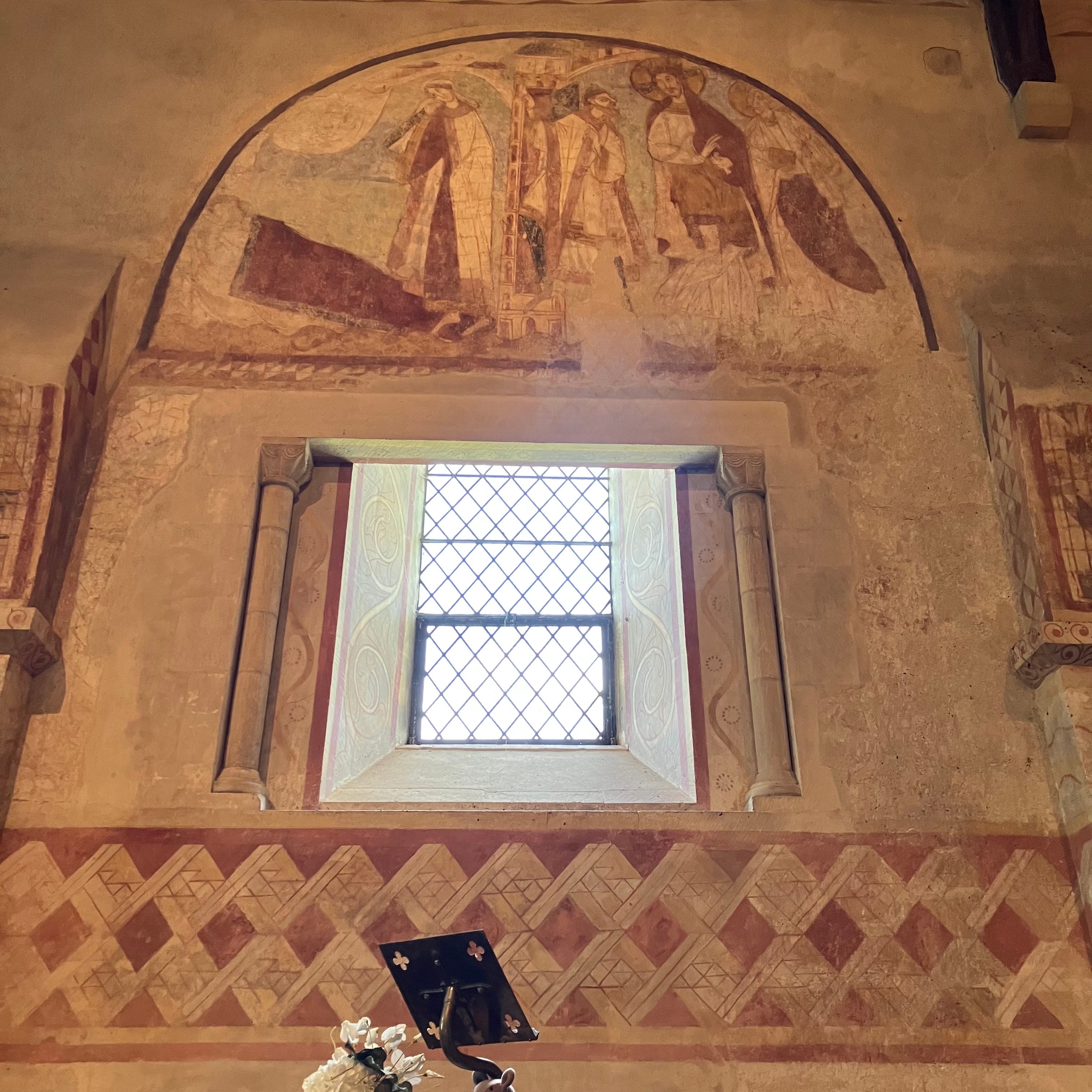
The best preserved of the unrestored murals is in the lunette above the pulpit. The scene, which features in several of the Gospels, including that of Luke, is of Jesus raising the twelve-year-old daughter of Jairus, one of the elders of the synagogue, from the dead. Or rather, it is of Jairus bringing Jesus to his house, where his daughter’s body lies still in death and her mother stands distraught, with resurrection but the faintest of hopes, at once desperate and laughable. It’s a moment of great poise, the moment before the miracle and its point of blazing pity, when the first terrifying heartbeat of revelation has almost arrived.
I really like this Byzantine-adjacent style, with its long, mournful, contemplative faces which seem to gaze inwards into a cloistered interior life of infinite horizons and immeasurable grace. Blessed are the eyes that see the things that they see. By way of contrast, Bell has made the faces of ‘Christ in his majesty…’ a touch too pre-Raphaelite, I think. Or perhaps not even that. His are a touch too decorative, bereft of inner life and that thousand-year stare.
Other scenes known to have existed, aside from those mentioned by Newcourt at the turn of the eighteenth century, include the ‘Women of Samaria at the well’ and ‘Abraham pointing to a ram caught in a thicket’, but there were of course many more. The crucifixion scene that Newcourt describes seems to have destroyed by the Victorians themselves, even as they were preserving and restoring the murals in the apse. Inconceivable, I know. (It reminds of me of that line from Wodehouse describing how the Victorians could rarely be trusted within reach of some bricks and a trowel.) In its place they inserted an archway to facilitate the installation of an organ.
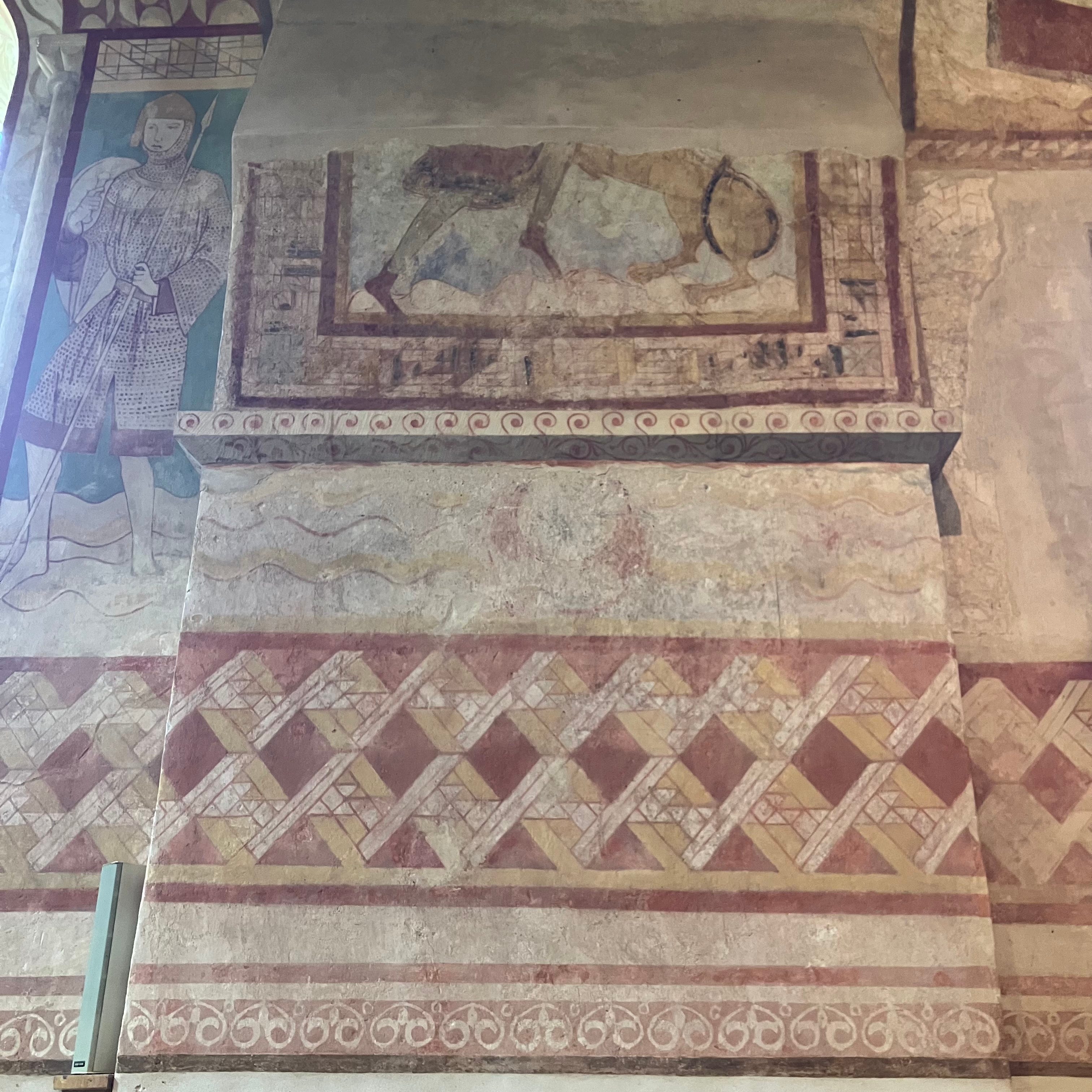
I think the only other recognisable scene is a fragment of Samson wrestling a lion, which, even though we only have their feet, seems full of energy and movement. And then, flanking a window, we have two knights, which again gives us a chance to compare Bell’s restoration, on the right, to the early-medieval original. The decorative motifs that are everywhere are, as Simon Jenkins has noted, oddly reminiscent of art deco.


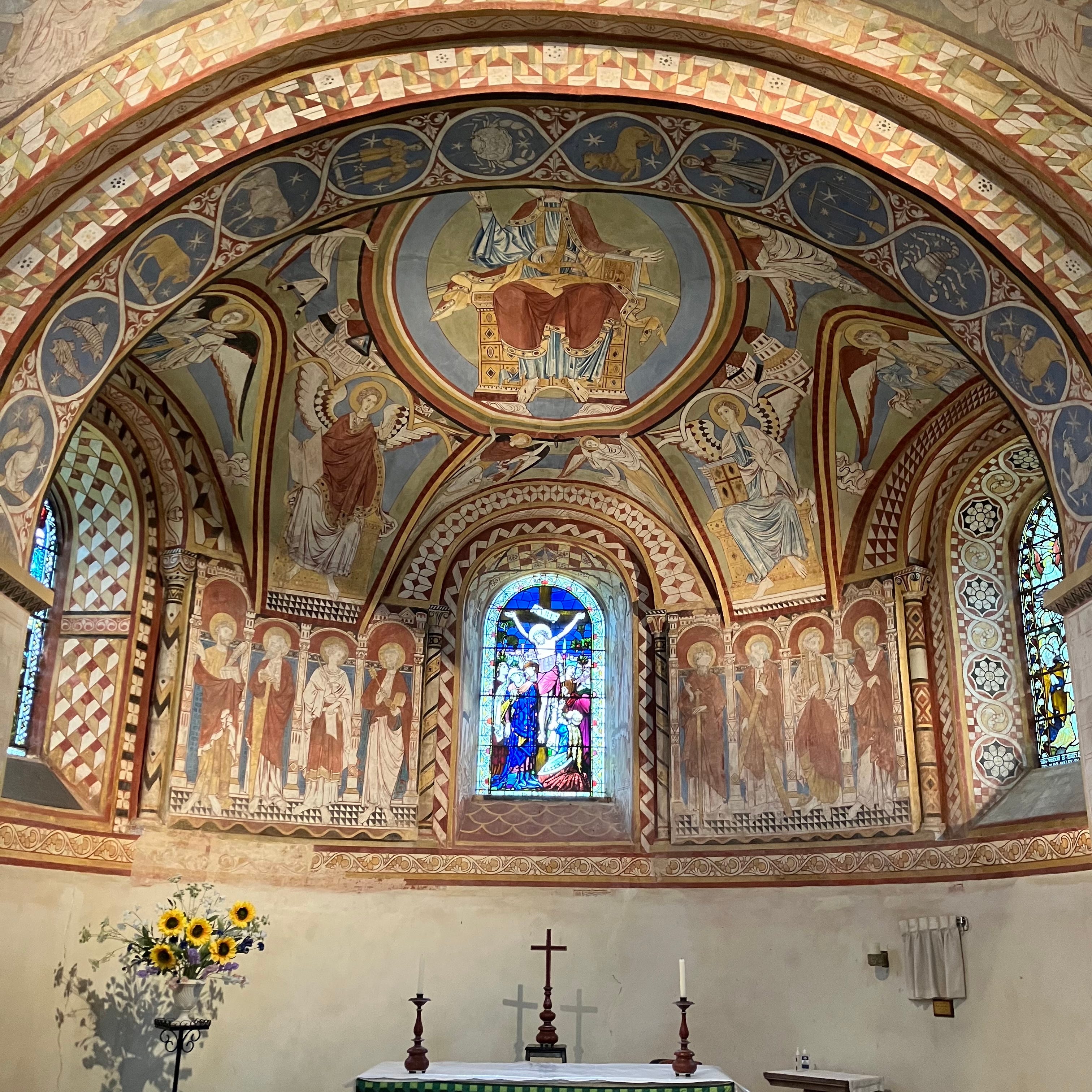
But let’s return to the apse. It has been suggested that the buildings that flank Christ in majesty, over the shoulders of the angels, portray the Norman manor house and the church itself in the mid-twelfth century. It seems a little unlikely to me, but really, I don’t have an opinion, although I can see it’s a nice idea to play with, refracting both time and space within the lovely graceful curve of the vaulting.
Is that necessary, though, to feel the history ringing through the space as if it were the dome of a bell? The whole mural already translates us into a different plane in which we share a present with our predecessors, breathing the same cool air as the Victorians, the conquering Normans and their Saxon subjects, the artisans and craftsmen with their gifts and designs, and countless craftsmen before them, reaching back through Constantinople and Byzantium to Rome and the earliest days of the church. The plaster is new and fresh, still wet on the Roman brick and Essex rubble of the wall, and the artist is about to make his first mark. It is hard not to shiver at the glory of it: the moment held on the in-breath, the fields of meaning, Christ in his majesty, infinity sequestered in a small room in England.


Meanwhile, if you like your history a little more grisly, Copford can supply that too. Let’s go back to Newcourt, who tell us:
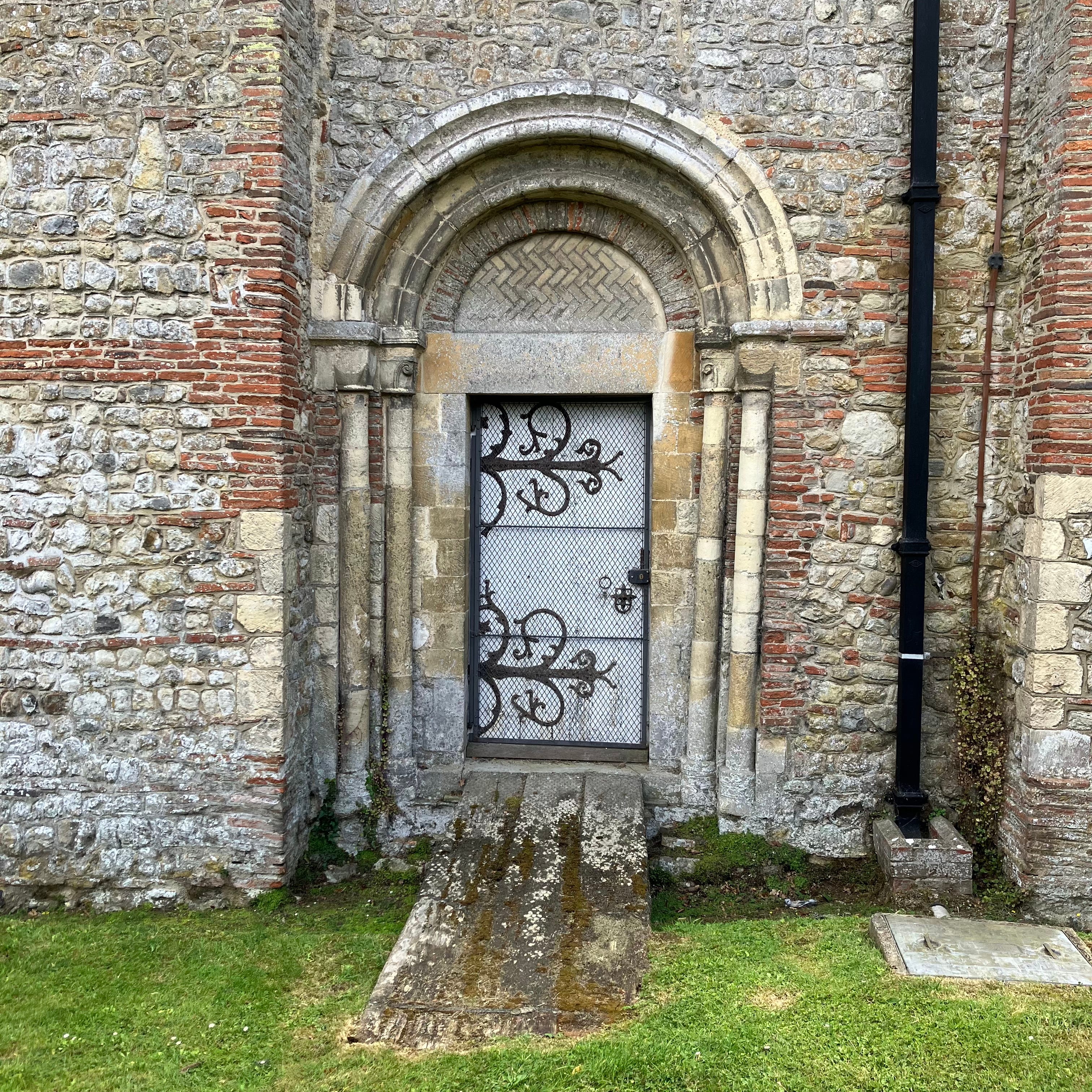
The Doors of this Church, are much adorn’d with flourish’d Iron-Work, underneath which is a sort of Skin, taken notice of in the Year 1690 when an old Man at Colchester, hearing Copford mention’d, said, that in his young time, he heard his Master say, that he had read in an old History, that the Church of Copford was robb’d by Danes, and their Skins nail’d to the Doors, upon which, some Gentlemen being curious, went thither and found a sort of tann’d Skin, thicker than Parchment, which is suppos’d to be human Skin, nail’d to the Door of the said Church, underneath the said Iron-Work, some of which Skin is still to be seen.
That surely couldn’t be true, could it? After all, the church was built a century or more after any Vikings were likely to have been laying waste to Essex. But Wright’s guidebook records that some pieces of what he calls ‘parchment’ were discovered around 1780 between the wood and the ironwork of one of the doors. Forensic examination early in the twentieth century, he reports, confirmed the parchment to be the skin of a fair-skinned male. Perhaps, Wright conjectures, a poacher was flayed for hunting the king’s deer.
And then there is Edmund Bonner, who we met briefly at the beginning of this. History remembers him, perhaps unkindly, as ‘Bloody Bonner’, the Bishop of London, zealous and abusive in his inquisitions, who oversaw the burning of dozens of Protestant martyrs under Mary I, including, most famously, Thomas Cranmer. (Estimates of those he put to the flames range from 120 or so up to around three times that number.) He refused to swear the oath of supremacy to Elizabeth I, was deprived of his bishopric – hence the loss of Copford to the crown – and spent the last ten years or so of his life in the Marshalsea, where he died in 1569. He was said to have been buried at midnight in the churchyard of St George's, Southwark, to avoid any expressions of public outrage, but in 1810 a workman at Copford found his coffin in the chancel close to the altar. It is unclear whether he was reburied here later, or if the initial report is untrue. Either way, it is a quiet resting place for such a turbulent man.
Thinking about his presence, though, one might say that, together with the white-washing of the walls under Edward VI, it shows the way this single church embodies the violent tensions of the Reformation and the Catholic response to it in sixteenth century England. His body might be a full stop for the thousand-year arc of Roman Christianity in this place.
But then I wonder what the parishioners felt about such a loathed figure of the Marian Counter-Reformation coming to rest beside their altar. A contemporary said that Bonner could never venture out in public for fear of his life. That must refer to London. Perhaps he was quietly welcomed in Copford. Twenty years earlier, the murals had been covered over, but there is no evidence that they were ever defaced, so the wilder tides of iconoclasm didn’t reach here. Likely the white-washing and the late bishop’s burial were carried out by at least some of the same people. A century later, Newcourt’s account of the paintings’ uncovering might be read as one of perfunctory indifference. But is there also a note of pride, a note of care? I don’t know. History might be tightly woven here but loose threads abound, so tempting to tease from their place.
NOTE: If you do visit Copford, take a pound coin or two! There is a meter at the back of the church which turns the lights on. You will want to see these murals with the lights on. Also the grille in front of the porch door is quite stubborn. Give it a good tug. We almost missed the church interior thinking it must be locked.
Oh, how fabulous! I've transcribed Copford's parish registers as I have some family from there, but hadn't seen such fabulous photos of the church before. I'll add a link to this newsletter from here: https://essexandsuffolksurnames.co.uk/parish-register-transcriptions/essex/copford-st-michael-and-all-angels/
Essex is full of historical treats and picturesque corners. I had a photo of the village I grew up in, in n-e Essex on my wallpaper at work and colleagues thought it was a Cornish fishing village!
I'm trying to think of places to recommend... Off the top of my head, Brightlingsea's church has impressive old brasses of the Beriffe family, and memorial tiles all around the walls for mariners lost at sea - it's an extraordinary number and includes my relative who was lost on the Titanic. And there's a massive Romantic-era marble memorial to a bloke who made loads of money in shipping insurance, ironically.
I don't call myself an Essex girl. When we moved out of the county when I was 15, I was teased by teachers at my new school for being an Essex girl. You're right that Essex has long had a bad rap, perhaps thanks to snooty London journalists. When I was writing my book about arsenic poisonings in Essex, after one trial write-up, the Times called it "that uneducated county"!! Shades of "Educating Essex" from a few years ago? A title that ground my gears as it implies that Essex is full of dimwits. Which is pretty funny because my senior school used to get the highest GCSE grades in the country. A feat The Sun reported as "Essex Girls On Top". How tasteful. :-/
Oh, that's my lifelong holiday stamping ground but I didn't know about Copford at all - straight on the next-time-we're-down-there list! I adored the Dulwich exhibition, and since then I've been reading Tirzah Garwood's autobiography Long Live Great Bardfield with much pleasure, and so I wonder if it was also a choice by her to end up in a beloved part of the world.