
Auden by Peter Ackroyd
The shambling life of England's most commanding twentieth-century poet
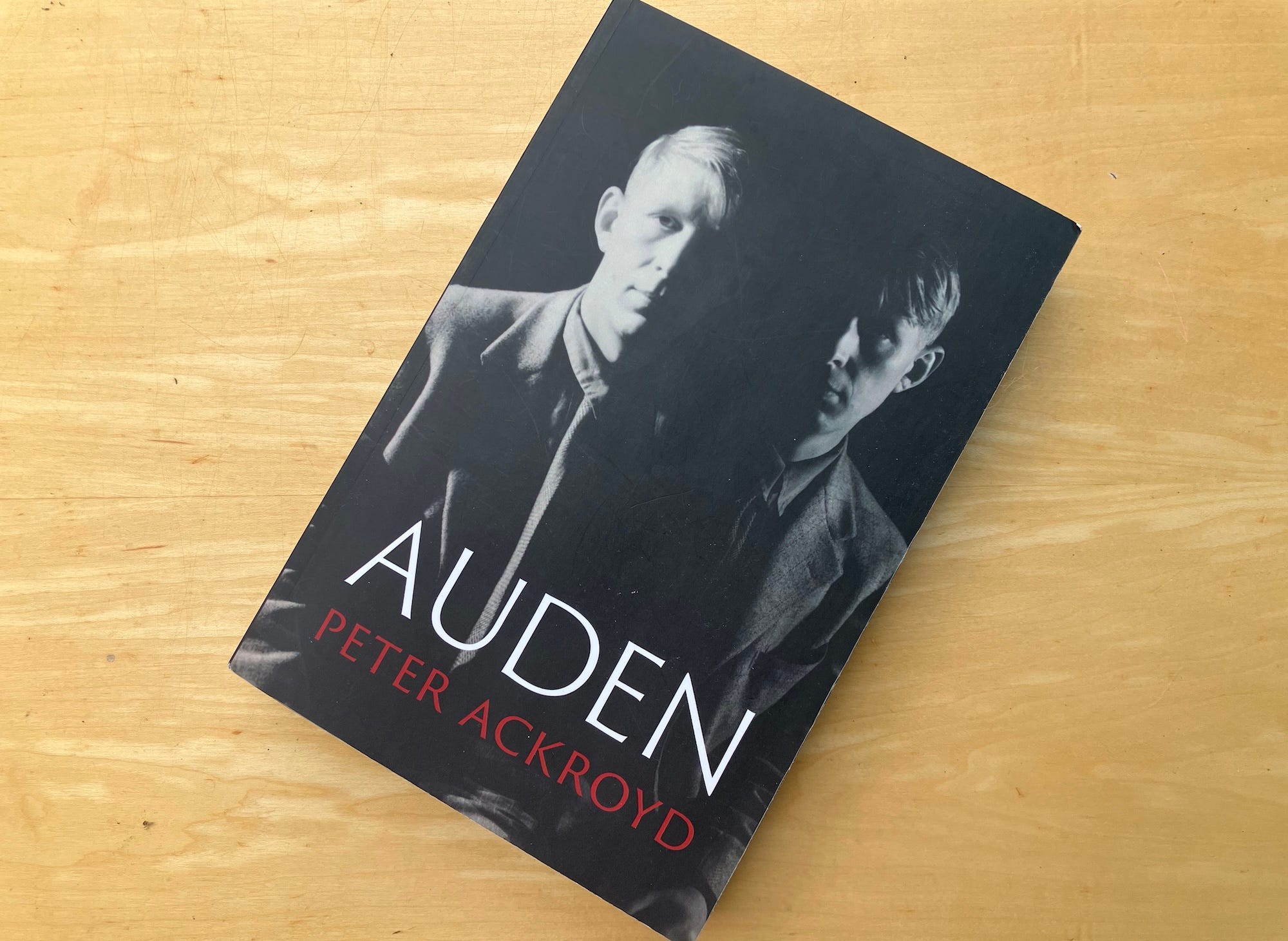
Ackroyd on Auden is a tantalising prospect: the biographer of Eliot and Pound – and of England too – on one of England’s most celebrated and more difficult twentieth-century sons.
Born to a prosperous middle-class family in 1907, Auden grew up in Birmingham. His mother was the dominant figure at home, he was her favourite son. Later in life, he often referred to himself as “your mother”, or “your old mother”, or “your leathery old mother” in letters to friends. After her death in 1941 he wrote that he “discovered what I never knew before, the dread of being abandoned and left alone”.
But surely he knew it already. Aware of his homosexuality early, he fell in love addictively, desperately, “a hopeless romantic” who yearned for a depth of intimacy that also terrified him. “If his feelings were even partially returned,” Ackroyd writes, “he thought he had fallen in love.” Even Chester Kallman, the love of his life – or, at any rate, the other half of his most enduring relationship – brought him much grief. They met in 1939 shortly after Auden fled Europe for America; they remained together, if not monogamously so, the rest of his life.
In fact, Auden seems to have spent much of his adult life in what one friend called “the swamps of self-torment”. In 1970, three years before his death, he arrived at Hannah Arendt’s New York apartment and drunkely proposed to her. “I finally saw the misery… and still found it difficult to understand fully what made him so miserable, so unable to do anything about the absurd circumstance that made everyday life so unbearable to him,” she wrote of the evening.
He began writing poetry at school at the prompting of a friend; it immediately became a vocation, a discipline to grip, a mountain to scale. He had a childhood obsession with mines and caves and other cold and empty spaces beneath the earth. That stayed with him too: it is almost too pointed a metaphor for his psychological life. The same might be said of his feel for the bleak landscapes of the north, most obviously embodied by Iceland, which he called his “holy ground”. A friend in America later noted his “aloof, reclusive personality, at the centre of which was massive loneliness”. In person, particularly in early life, Auden seems to have been good company: energetic, charming, funny, amiable and, if only sometimes, attentive. But it is Auden the walking cavern who dominates here, long addicted to cigarettes, hymns and the sound of his own voice sermonising on his latest truth. He made a cult of whatever he was doing, Stephen Spender said.
His choice of clothing was determinedly, aggressively haphazard. “He looked exactly like a half-witted Swedish deck-hand,” a colleague on the film Night Mail wrote. An American student thought him quintessentially English, “like a thatched cottage”. Dishevelment was a mark of honour. So, perhaps, was smell: his fingernails were dirty, bitten to the quick, his fingers stained with nicotine; he disdained underclothes and wore everything long past the point of cleanliness. “He is the dirtiest man I have ever liked,” Stravinsky said. Maids commented on soap unused and towels unfolded. “I work, am very chaste, and never wash,” he wrote to a friend from his house in Ischia in 1949. The first and last points, at least, cannot have been a surprise.
Edmund Wilson noted that “in a puritanical way, [Auden] seems to feel he is acquiring merit by living… in the most unattractive way possible”. Which suggest that the slovenliness with which Auden surrounded himself was a choice, and perhaps in some sense it was: Auden later told Wilson that “I hate living in squalor – I detest it! – but I can’t do the work I want to do and live in any other way.” His life, he once said, was “primarily a continuous succession of choices between alternatives”. He seems to have framed such alternatives as opposites.
Ackroyd is clear-sighted about Auden’s “almost juvenile mode of behaviour” – a rare hint of moral judgement – echoing David Gascoyne’s observation that he “has an air of disguising only with a difficultly acquired social manner the petulance and embarrassment of an adolescent”. There were tantrums late into life, usually about trivial things – an insufficiently grand hotel room in Venice, for example – which friends found hard to reconcile with his intelligence and intellect.
There were always at least two Audens, each opposed to the other, and the trick is to keep them both in focus. Against the disorder was an obsession with time-keeping that grew ever more dominating. “The surest way to discipline passion is to discipline time,” he said. Meals, meetings, work: everything was regimented, ordered by the minute. “It resembled a military discipline,” Ackroyd writes, “although it was never entirely clear who the enemy was.”
The clarity and discipline of metre surely fulfilled the same emotional function, the same counterweight to chaos, as the clock-watching; Auden’s mastery of it is unrivalled in twentieth-century English poetry. It’s a surprise then to find him employing someone in America to correct the metrical structure of his work, a role he described as his “prosodic conscience”. If he didn’t trust himself in metre, what else was left?
If love made him weep his pints, he rehydrated with alcohol: always partial to a precisely chilled vodka martini – preferred ratio a punchy three to one – in later life he was downing a bottle of vodka a day. Benzedrine was another addiction, in opposition to the booze. How did he manage to write as much as he did and with such music and control? Ackroyd shows us Auden at work amidst the trash he trailed around with him, but the work itself is sparingly addressed. The poetry is largely here to illuminate the life, or perhaps to throw it into relief; there are sharp critical judgements along the way but this is not a literary biography.
“I’m ashamed of its obscurity which is swank,” Auden wrote of The Orators, an early work. But he increasingly liked to swank: “He made statements rather than conversation,” Ackroyd writes, “and he gave lectures rather than opinions.” His authoritative manner shaded readily into bullying. Auden found his fondness for abstraction hard to shake too; Ackroyd’s observation that he “seldom dared to be simple” is an acute one. It seems related to Auden’s distrust of inauthenticity in his work; he strove over the years to eliminate “false emotions, inflated rhetoric, empty sonorities”, he said, famously rewriting earlier poems to fit his later conception of himself. Some, as with ‘September 1, 1939’, he tried to suppress altogether. Firm allegiance, even to himself, was difficult.
The poet Ackroyd’s Auden most reminds me of is Tennyson, particularly the young Tennyson of Richard Holmes’s recent biography The Boundless Deep: they seem profoundly alike in misery, metrical skill and poor personal hygiene. They were alike in self-regard too: Auden’s claim to have written a poem in every known metre seems to echo Tennyson’s boast that knew the metrical quantity of every English vowel (except, bathetically, those in the word ‘scissors’). Thinking of Tennyson, Auden wrote: “it is interesting to speculate on the relation between the strictness and musicality of a poet’s form and his own anxiety. It may well be, I think, that the more conscious he is of an inner disorder and dread, the more value he will place on tidiness of the work as a defense.”
Did Auden see himself in that description? His dismissal elsewhere of Tennyson as “undoubtedly the stupidest” of English poets has what seems to me a revealing degree of visceral disgust. He once wrote, in a poem addressed to Kallman: “Beloved, we are always in the wrong, / Handling so clumsily our stupid lives” – one of those rare, daring, devastatingly simple remarks in his work.
Such directness and emotional candour did not come easy. “Even in in his private meditations,” Ackroyd notes, “he relies upon theory and generalisation.” Auden’s journal of his time in Berlin in the 1930s records both details of his sexual adventures and his Freudian self-analysis of them: “Even as he was discovering sex, he was analysing it,” Ackroyd writes. Perhaps such private abstractions were another form of discipline, something to set against those disorders and dreads.
Ackroyd’s biography strikes me as more than somewhat Audenesque. The tone is frank, declarative, unsentimental and devoid of cant, the insights are judicious, shrewd, humane and perceptive. It is afraid of neither the aphoristic – “The cerebral are never more in search of an answer than when their illusions are broken” – nor the occasional catty aside – “While Auden was in Ann Arbor, Kallman pursued his own career or what passed for one”.
Auden the man is here in all his complexity and doubleness. It is a sorry read in places. Does the life expand our understanding of the work? Yes, but often as much by counterpoint as anything. Weighing one against the other, both aspect of Auden’s essential duality in clear focus, the calm order of the poems seems more miraculous than ever – full of all the elegance, assurance and gnomic certainty that so escaped him in the still dark lonely spaces of daily life.
I've rarely read a review which has so much made me want to read the book (now I'll have to). Thank you for this - it was a fantastic read!
Doesn't say much for the arts, any of this, does it? Goodness me, how depressing. (Agree incidentally Mathew with your comment below about not taking this impression from the Carpenter biog!)